A federal prosecution in Florida has turned into a constitutional battle over who has the authority to determine voter qualifications in U.S. elections.
On October 1, 2026, U.S. District Judge David S. Leibowitz dismissed the federal case against Chelsea Michelle Ann Cox, a Jamaican national accused of voting in the 2020 presidential election. Leibowitz ruled that the federal statute used to prosecute her, 18 U.S.C. § 611, was unconstitutional as applied to her case.
The decision does not give noncitizens a right to vote. Instead, it limits the federal government’s ability to use this particular federal law to prosecute someone for voting while not being a U.S. citizen. Reuters’ report on the ruling confirmed that the decision applies specifically to Cox and is not binding on other federal courts.
The Justice Department is challenging the ruling, while dozens of similar cases remain in the federal courts.
How the Cox Case Began
Cox’s case dates back to her arrival in the United States.
According to court filings, Cox entered the country from Jamaica in 1999 on a tourist visa and remained after her authorized stay expired. Prosecutors later alleged that she used a fraudulent U.S. Virgin Islands birth certificate to obtain a Florida driver’s license.
She subsequently registered to vote.
Government records indicated that Cox voted in federal elections between 2012 and 2020. However, prosecutors could only pursue the 2020 vote because of the applicable statute of limitations.
The Justice Department charged her in 2025 under 18 U.S.C. § 611, a federal statute enacted in 1996 that makes it a crime for a noncitizen to vote in an election involving federal candidates.
The offense is generally punishable by a fine, imprisonment of up to one year, or both.
The prosecution initially appeared to be a conventional illegal-voting case. Cox’s defense, however, challenged the government’s authority to bring the prosecution at all.
The Constitutional Argument
Cox’s lawyers argued that Congress does not have the constitutional power to establish voter qualifications for federal elections in the manner used by § 611.
The argument focused on the structure of the U.S. Constitution.
Article I establishes rules concerning congressional elections and connects the qualifications of voters for the House of Representatives to the qualifications required for voting for the most numerous branch of a state’s legislature.
Leibowitz interpreted those provisions as giving states the primary authority to determine who qualifies as a voter.
That distinction became the foundation of his decision.
The government argued that Congress has broad authority over federal elections through the Constitution’s Elections Clause. Prosecutors also relied on congressional powers involving immigration, foreign affairs and election regulation.
Leibowitz rejected the argument that those powers allowed Congress to create a separate federal voter qualification and make violating it a federal crime.
The detailed report on the decision notes that Leibowitz distinguished between regulating the mechanics of elections and determining the qualifications of the electorate.
The difference is important.
Congress can regulate many aspects of federal elections, but Leibowitz concluded that this does not mean Congress can independently decide who is qualified to vote and then criminalize conduct that violates that qualification.
The Supreme Court Cases Behind the Decision
The constitutional dispute brought several Supreme Court precedents into the case.
One was Oregon v. Mitchell, the 1970 case concerning Congress’s authority to lower the voting age for federal elections.
The government relied on the decision as evidence that Congress possesses significant authority over federal voting.
Leibowitz found that precedent insufficient. Oregon v. Mitchell was a fractured decision, and the justices did not agree on a single constitutional theory establishing broad congressional power over voter qualifications.
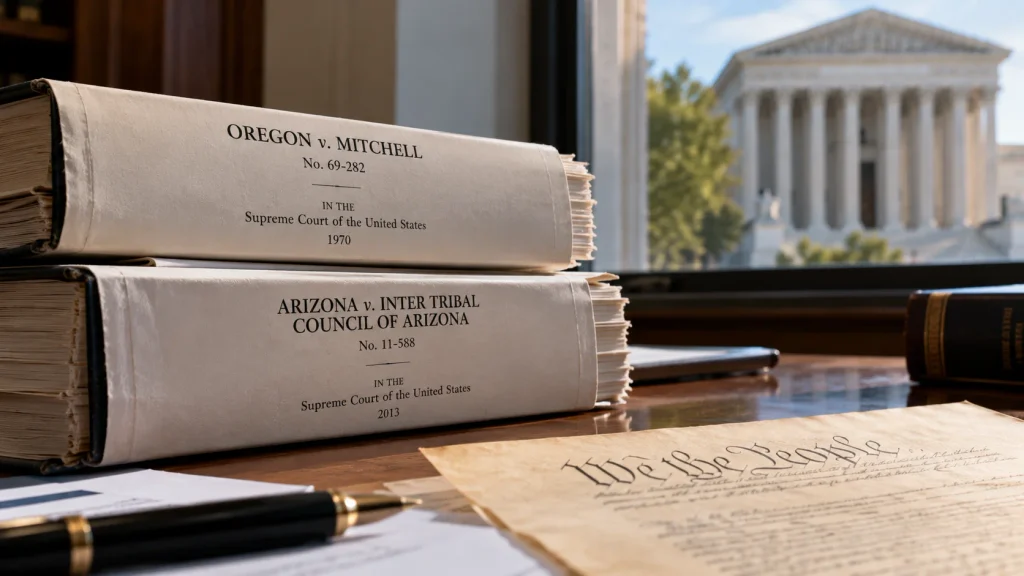
The judge also considered Arizona v. Inter Tribal Council of Arizona, a 2013 Supreme Court decision addressing the relationship between state voter qualifications and federal election regulation.
Together, these cases helped frame the distinction at the center of Cox’s prosecution: federal authority over election administration is not necessarily the same as federal authority to determine the electorate.
The Judge Did Not Legalize Noncitizen Voting
The most important point about the ruling is also the easiest to misunderstand.
Leibowitz did not declare that noncitizens have a constitutional right to vote.
He did not strike down state citizenship requirements.
He did not prevent Florida from prosecuting unlawful voting under its own laws.
Instead, he held that the federal government could not prosecute Cox under § 611 because Congress lacked the constitutional authority necessary to create and enforce that federal voter qualification.
Al Jazeera’s coverage of the decision likewise emphasizes that the ruling applies to Cox’s case and does not bind judges elsewhere.
That limitation matters because the decision came from a federal district court. Other federal judges can reach different conclusions, and the Justice Department’s appeal could change the legal position.
Other Noncitizen Voting Cases Are Moving Differently
Cox is one of several defendants challenging the federal government’s use of § 611.
Reuters reported before the ruling that at least four other defendants had raised similar constitutional arguments, while roughly 45 noncitizen voting cases were pending around the country.
One case involved Wilner Renaud, a Haitian national accused of voting in the 2022 federal election.
U.S. District Judge Jacqueline Becerra rejected Renaud’s constitutional challenge and allowed his prosecution to continue. Renaud was later acquitted by a jury.
That result is important because it shows that Leibowitz’s decision has not automatically changed how other federal courts are handling these prosecutions.
The courts are currently dealing with different defendants, facts and legal arguments, and there is no nationwide ruling requiring every judge to follow Leibowitz.
The Justice Department Is Fighting Back
The Justice Department has made clear that it disagrees with the ruling.
The government is appealing the dismissal, putting the constitutional question before the U.S. Court of Appeals for the Eleventh Circuit.
CBS News reported that the Justice Department was moving to challenge the decision.
The appeal could become more important than the original district-court ruling.
An appellate decision affirming Leibowitz would give defendants in other cases considerably stronger authority for challenging § 611.
A reversal would restore the federal government’s ability to rely on the statute in the Eleventh Circuit, subject to any further review.
If federal appellate courts eventually reach conflicting conclusions, the dispute could make its way to the U.S. Supreme Court.
Federal Prosecutors Are Still Bringing New Cases
The Cox decision has not stopped the federal government’s broader election-enforcement campaign.
On October 5, the Justice Department announced charges against 16 noncitizens in election-related cases involving allegations of illegal voting, fraudulent voter registration and false claims of U.S. citizenship.
The Justice Department’s October 5 announcement shows that federal prosecutors are continuing to pursue election-related cases despite the constitutional challenge to § 611.
The new cases involve different allegations and different federal statutes. Some defendants are accused not only of voting unlawfully but also of falsely claiming U.S. citizenship during voter registration or other government processes.
That distinction could become important as the Cox litigation develops.
Leibowitz’s ruling concerns the federal prohibition on voting by noncitizens. It does not eliminate every federal criminal law that can potentially apply when someone makes a false claim of citizenship or commits another election-related offense.
The Numbers Put the Cases in Context
The legal dispute is developing alongside a much larger political debate over election integrity.
The Trump administration has made noncitizen voting a major enforcement priority ahead of the 2026 midterm elections.
Yet available prosecution data suggests that confirmed noncitizen voting remains relatively uncommon.
A Reuters investigation found that 129 people had been charged under the federal “voting by an alien” law since 2021. The investigation found that many defendants were lawful permanent residents who had registered or voted because they misunderstood their eligibility or received incorrect information.
Reuters also reported that none of those 129 defendants had been accused of conspiring to influence an election, supporting a particular candidate or being paid to vote.
Reuters’ investigation into the broader noncitizen-voting crackdown found that the available cases did not support claims of a widespread organized operation involving noncitizens casting ballots to influence U.S. elections.
That does not make unlawful voting permissible. It provides context for the scale of the problem compared with the size of the U.S. electorate.
Why the Ruling Matters Beyond Cox
The unusual feature of the Cox case is that the court did not simply decide whether the defendant violated an election law.
The judge questioned whether Congress had the constitutional authority to create the federal offense in the first place.
That makes the dispute a question of federalism and constitutional power.
If Leibowitz’s reasoning survives appeal, Congress could face a significant limitation on its ability to establish independent federal voter qualifications.
States would retain their authority to determine voter eligibility under their own constitutional and statutory systems.
The federal government could still regulate election procedures and enforce other federal laws, but § 611 would face a major constitutional obstacle.
The ruling could therefore affect not only Cox but also other defendants who are relying on the same constitutional argument.
What Happens Next
The immediate next step is the Justice Department’s appeal.
For Cox, the district-court prosecution has been dismissed. But the government’s appeal means the constitutional dispute is still active.
For other defendants, the ruling provides a new argument that can be raised in federal courts, although judges outside Leibowitz’s courtroom are not required to follow it.
For the Justice Department, the case presents a direct challenge to a statute that prosecutors have increasingly used during the administration’s campaign against alleged noncitizen voting.
The Eleventh Circuit will now have an opportunity to examine constitutional reasoning.
Until then, the most accurate description of the ruling is not that America has legalized noncitizen voting.
Instead, a federal judge has ruled that Congress exceeded its constitutional authority when it used federal criminal law to impose its own voter qualification on noncitizens, and that decision is now headed toward appellate review.
The case that began with Chelsea Cox’s alleged 2020 ballot could therefore become an important test of the constitutional boundary between state control over voter qualifications and federal power over elections.