
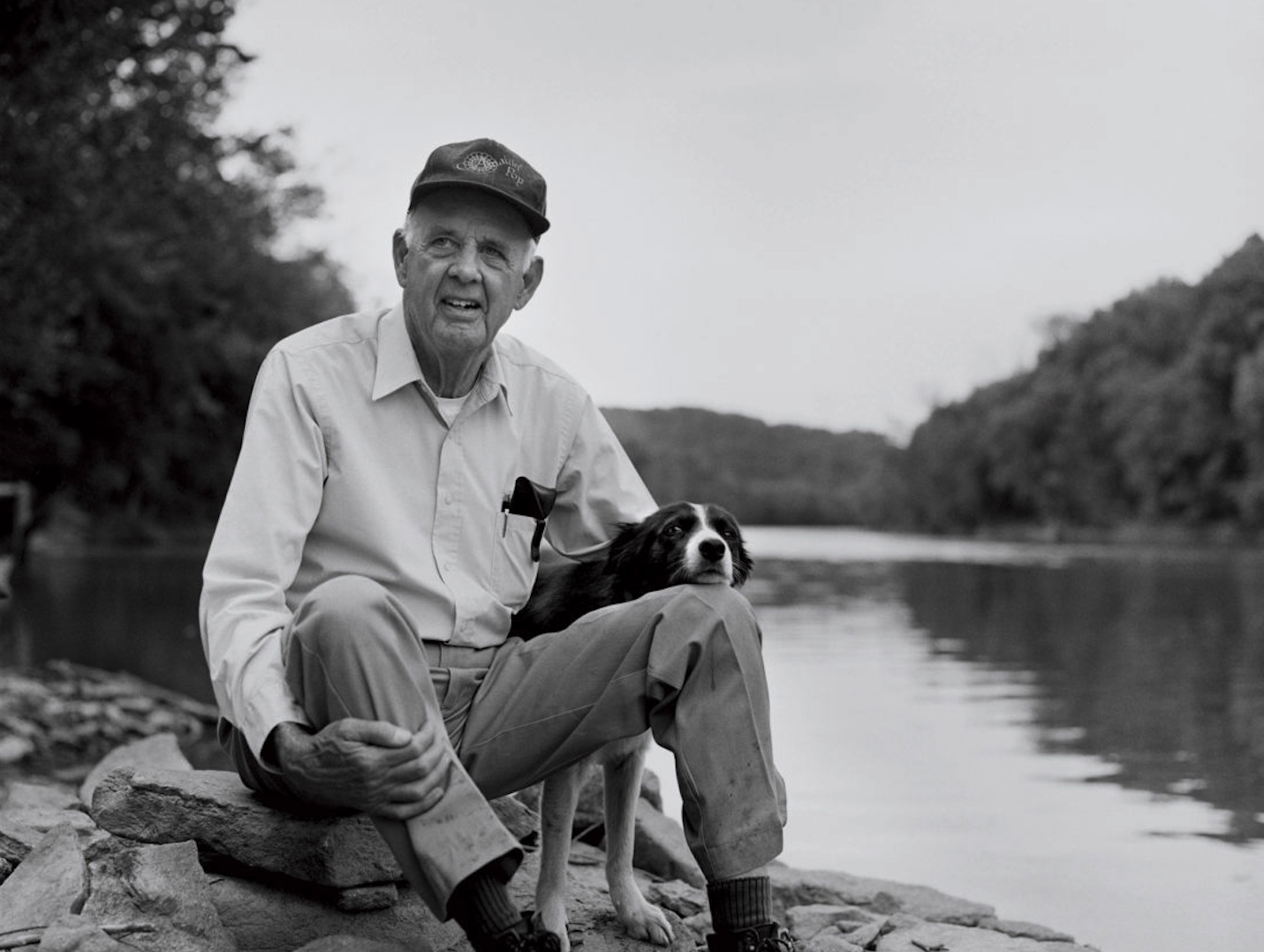
The poet of Port William has left the fields. His words remain.
For decades, Wendell Berry appeared to go against the grain of American society. While cities grew, technology advanced, and farming became more industrialized, Berry remained committed to simpler things: soil, rivers, farms, family, community, and meaningful employment.
Wendell Erdman Berry passed away at the age of 92 on August 31, 2026, in the small river village of Port Royal, Kentucky. This is the same Henry County where he was born, raised, farmed, and transformed into one of the most subtly potent landscapes in American literature. His daughter Mary Berry confirmed his death, which was initially reported by the New York Times.
For almost 70 years, Berry did something that very few contemporary authors accomplished: he stayed. Berry purchased a steep, narrow farm called Lane’s Landing near Port Royal and authored more than fifty volumes, including novels, poems, and essays, from a long desk overlooking the Kentucky River, while his peers chased New York and the lecture circuit. However, beneath them all, there was a recurring concern: What was America losing in its pursuit of modernity?
Berry’s response was never to simply withdraw from the city and relocate to the countryside. It was to slow down, observe our surroundings, comprehend the effects of our decisions, and keep in mind that a comfortable life isn’t necessarily fulfilling.
His demise brings an end to the life of a writer who, like Faulkner, established a whole imaginary county before leaving his desk to personally resist nuclear power, mountaintop removal mining, and industrial agriculture. This writer was once compared to both Thoreau and Faulkner.
Who Was Wendell Berry?
Born in 1934 in Henry County, Kentucky, into a family with a deep connection to the region, Berry grew up on rural farms and river settlements that subsequently became Port William in his literature. “I was born here in Henry County. I grew up in these little towns, and in the countryside, on the farms,” he told Sojourners magazine. “All my early memories are here”.
He received a bachelor’s and master’s degree in English from the University of Kentucky before attending Stanford as a Wallace Stegner Fellow to study creative writing. Later on, he was a professor at the University of Kentucky and New York University.
However, his career did not take the standard course of an academic writer who progressively distances himself from the real world
Berry ultimately returned to Kentucky. He settled there and farmed for decades with his wife, Tanya. The farm was more than just a fascinating aspect of his life story. It became essential to his comprehension of literature in general.
According to the Library of America, Berry is a novelist, poet, farmer, environmental writer, and activist and in each of these roles he has been a vocal advocate of rural life. He authored over fifty works, including eight novels, sixteen essay collections, and over twenty-five books of poetry.
In a similar vein, the National Endowment for the Humanities observed that although Berry’s work encompassed poetry, fiction, environmental writing, and cultural criticism, he frequently identified himself first as a farmer. That distinction is important. Berry wrote on more than just rural America. He lived within the questions he penned.
The Relevance of Wendell Berry’s Books
The number of books written by Wendell Berry may seem overwhelming at first. His imaginary village of Port William, Kentucky, is the subject of a vast body of work that includes novels, poetry collections, essays, and more. However, a lot of it is connected by a thread. Berry was curious about what happens when people lose touch with the communities, places, and jobs that support them.
In his 1960 book Nathan Colter, he introduced readers to the imaginary Kentucky town of Port William, which would later serve as the focal point of a remarkable creative endeavor. According to Penguin Random House, the book marks the start of Berry’s extensive investigation of duty, community, land, and the ties that unite people.
Eight novels and numerous short stories were subsequently produced from the Port William series. According to the Library of America, they follow families whose lives become entwined through what Berry referred to as “membership,” painting a picture of rural America spanning generations.
One of the keys to comprehending Berry is that concept of membership.
An individual is not a solitary consumer. Someone has a place to call home-to a family, To neighbors, to a landscape, or to work. And ultimately, to the preceding and succeeding generations.
“Wendell Berry’s “A Place on Earth” and the Significance of Grief”
One of Wendell Berry’s notable books is A Place on Earth.
The novel, which was first published in 1967, takes place at Port William during World War II. The protagonist is farmer Mat Feltner, whose family must deal with the heartbreaking news that his son, Virgil, is missing in action. However, Berry does not view the war as merely a secluded historical occurrence.
Conflict enters Port William’s homes, fields, and relationships. This is what distinguishes Berry’s novel from his other works. Ordinary individuals witness major events in history. A war results in a missing son. History turns into a vacant seat. A family’s personal sorrow turns into a national catastrophe. And beneath it all, the land goes on, life goes on.
The publisher has characterized the novel as a depiction of a community united by sorrow, hope, and war. This is another way that nostalgia and Berry’s fiction diverge. He wasn’t just claiming that the past was better. He wanted to know what happens when individuals lose the ability to stay linked, both to each other and to the actual places where their lives take place.
The Poem that Transformed Wendell Berry into a Comforting Being.
“The Peace of Wild Things” is arguably the work that has made Berry well-known outside of the literary community. Berry’s 1968 collection Openings featured the poem for the first time. Its idea is remarkably lucid. A person awakens in the middle of the night, terrified not just of himself but also of his children and the future. Instead of directly addressing the world’s problems, he goes outside. He comes upon the natural world, water, birds, and stars. And for a moment, tranquility replaces anxiety What the poem doesn’t promise contributes to its enduring power. Berry does not claim that everything will be resolved by nature. He does not claim that fear is illogical.
He provides something more subdued: the chance to step outside of one’s own nervous thoughts and remember that life is greater than the challenges that now dominate it. Berry is recognized by the Poetry Foundation as a poet whose poetry frequently honors the sacredness of everyday existence and the natural environment. Additionally, Berry’s reading of the poem has been saved by the On Being Project, allowing viewers to hear his voice firsthand. This contributes to the explanation of why “The Peace of Wild Things” is still popular among people who are not often drawn to poetry.
Berry’s Poetry Extended Beyond Nature
Berry is likely to be defined as a “nature poet.” Much of the logical reasoning underlying his poems would be overlooked by that. Farming, labor, marriage, mortality, aging, community, war, responsibility, and the boundaries of human control are recurring themes in his poetry. The Poetry Foundation features several collections, including The Broken Ground, Clearing, The Selected Poems of Wendell Berry, A Timbered Choir, Given, and This Day: Collected & New Sabbath Poems. His poetry often appears explicitly simple. Part of the goal is to maintain simplicity. Berry didn’t trust the notion that complex language is necessary to convey difficult concepts.
A field is a field at times.
A river is just that—a river.
Someone passes away.
A family recalls.
Someone plants something could be harvested by a future generation.
Berry’s constant questions about what it means to live ethically within the ordinary turn it into a philosophical concept.

“How to Be a Poet”: Berry’s Philosophy
“How to Be a Poet” is one of Wendell Berry’s poems that is commonly found online.
The title reads like a writing lesson. The poem expands into something far broader. Wendell Berry begins by directing them to find a spot to sit and then to keep silent. He progresses through affection, reading, knowledge, skill, patience, and work before arriving at silence, place, and the natural environment.
In January 2001, the poem was published in Poetry magazine. The surprising thing is that Berry’s guidance on how to become a poet sounds quite much like his advice on how to become a person.
Slow down ,observe, read, work. and be patient.
That is not especially fashionable counsel in the age of continual notifications and algorithmic feeds. Perhaps this is why it continues to captivate readers.
Berry vs. Modern Technology
Wendell Berry was well-known for his skepticism about technology, yet even this aspect of his reputation requires some complexity.
He wasn’t just an anti-technology stereotype. Scale and consequence were his deeper concerns. A technology system, business procedure, or machine might be helpful, but Berry kept asking the same question:
What effects does it have on the local communities and interpersonal relationships?
His essays, including “Why I Am Not Going to Buy a Computer” and “Think Little,” as well as The Unsettling of America and later works on environment, community, and technology, are included in the Library of America collection.
Thus, his criticism extended beyond his own way of living. He was challenging an economic culture that might become so preoccupied with productivity and efficiency that it neglected the people, land, and communities that were impacted by that endeavor.
“The Unsettling of America”: Berry on Agriculture
One of Berry’s most important pieces of cultural criticism was The Unsettling of America, published in 1977.
The book explores the connections between agriculture, culture, and community while arguing for the value of locally adapted farming. The entire book is part of the Library of America’s collection of articles written by Berry between 1969 and 1990.
Berry’s status as a farmer becomes particularly significant at this point. He was not taking a merely theoretical stance while opposing modern agriculture. He was a farmer discussing farming. His main contention was that agriculture is never only about growing food. It molds societies. It molds topography. Family structures are shaped by it. Local economies are shaped by it. In the end, it molds the culture itself.
The “Port William” Universe: Berry’s America
Perhaps Berry’s most significant literary achievement was not a single poem or article.
It was Port William.
Berry revisited characters at various ages in this fictional Kentucky town for over fifty years, setting seemingly normal lives against significant historical shifts. The project, according to the Library of America, consists of eight novels and forty-two short stories that span the Civil War to World War II. Berry was able to achieve something out of the ordinary because to its structure. He was able to present history in its entirety. He started with farmers, families, marriages, deaths, friendships, and arguments rather than presidents, wars, and economic figures. History took place all around them. However, they encountered life. And Berry’s work began to revolve around that distinction.

Honoring Berry’s Unusual Legacy
Berry subsequently rose to become one of America’s most respected literary personalities.
He received the National Humanities Medal from President Barack Obama in 2010. Berry’s body of work spanning poetry, fiction, environmental writing, and cultural critique was acknowledged by the National Endowment for the Humanities.
According to the Library of America, he was also awarded the Ivan Sandrof Lifetime Achievement Award by the National Book Critics Circle in 2016 and elected a Fellow of the American Academy of Arts and Sciences in 2013.
However, Berry never developed into the kind of well-known author whose public persona relied on frequent appearances. His power originated elsewhere. He kept going back to the same place of origin. The farm, the neighborhood, the page.
Best Wendell Berry Books for Beginners
Since Berry wrote in a variety of formats, there is no one right place to start. However, readers can approach his work in a variety of ways.
Regarding poetry:
Start with The Selected Poems of Wendell Berry or The Peace of Wild Things and Other Poems. Poems on nature, love, death, belonging, and comfort are included in the former.
Regarding fiction:
Start with either A Place on Earth, the second book in the series, or Nathan Colter, the first Port William book.
For essay and ideas:
One of the best locations to see Berry’s views on agriculture, society, and industrial culture is The Unsettling of America.
For a more comprehensive summary:
What I Stand On: The Collected articles of Wendell Berry 1969–2017, published by the Library of America, compiles 77 articles from Berry’s career.
Why Berry Matters More Now
Berry’s legacy is ironic. He devoted a large portion of his life to denouncing a society that was fixated on technology, speed, and consumption. However, those same circumstances might be fostering a new generation of readers who are drawn to his writing.
“How to Be a Poet” is discovered by those who are overtaken by screens.
“The Peace of Wild Things” is discovered by those who are worried about the future.
The Unsettling of America is discovered by those who are skeptical of industrial food systems.
People who are unsure about the true meaning of community come across Port William.
And those who wonder if living a slower life is feasible can find a writer who has done more than just speculate. He made an effort to live it. In the end, that might be the most significant aspect of Wendell Berry’s tale. He didn’t establish his reputation by relocating frequently.
He remained. He observed. He was a farmer. He penned. He disagreed. He listened. And that focus developed into an exceptionally big corpus of American literature over the span of more than 60 years.

Berry’s Final Lesson
Wendell Berry’s writings can be interpreted as a defense of farming. It can be interpreted as writing on the environment. It can be interpreted as poetry, rustic literature, political criticism, or Christian contemplation.
Beneath all those classifications, however, comes a more fundamental idea.. A good life demands relationships, connection to the land, with relatives, with neighbors, at work, with recollection, with restrictions, as well as with the future.
Berry’s death is therefore more than just a literary obituary. It marks the demise of a writer who spent decades urging Americans to reevaluate something they believed they understood: what it means to be a part of a community.
His books have not been lost.
Port William still exists.
The poems are still there.